Experiment

A 4-post collection

Newer isn’t better: why I switched to a 100-year-old razor

It’s very easy to be different, but very difficult to be better. — Jony Ive

This is a post about shaving.

For years I used whatever razor was easiest to buy.

Gillette. Harry’s. Subscription refills. Plastic handles. Multi-blade cartridges.

A lifetime of marketing persuading me a “better” shave would be available with every new version.

Two blades. Three blades. Five? Why not!

It felt like progress, and who was I to disagree? Everyone I know has one of the well-known brands, and every ad I see shows me that the latest gaudy multi-blade razor really is “the best a man can get”.

But recently I started questioning that assumption.

Is this actually better? Or is it just newer and marketed better?

So I tried something older: wet shaving.

A safety razor. A brush. Proper soap. A setup that hasn’t fundamentally changed in decades.

It’s been a bit of a revelation.

The quality of shave

The biggest surprise was the shave itself.

More blades are supposed to mean a closer shave. In reality, it often means more irritation—multiple blades dragging over the same skin.

A safety razor is the opposite. One blade.

You slow down. Let the weight of the razor do the work.

The result is a closer shave with less irritation and fewer ingrown hairs.

It feels calmer, more deliberate, and less like scraping plastic across your face.

Skin and experience

Wet shaving isn’t just the blade, it’s the process.

You build a lather. You prepare your skin. You take a minute instead of rushing through it.

My skin feels noticeably better. Less redness. Less dryness. And the act itself has become something I look forward to.

There’s something grounding about it.

In a world optimised for speed, it forces a little slowness.

The cost

Cartridge razors are expensive. There’s a good reason most pharmacies lock them down and hide them behind the counter.

It can cost £10–£20 for a set of refills.

So a single cartridge will often be ~£1-2.

Safety razor blades cost pennies.

Even factoring in a razor, brush, and soap, the ongoing cost drops dramatically.

It’s one of those rare cases where the higher-quality option is also cheaper.

So much of the shaving industry today is seemingly focused on newer and flashier, with “improved formulas”. But so much of the cost you pay goes to profit margin and marketing. And the rest goes to product and packaging that I’d argue doesn’t need to exist.

The environmental angle

This was part of what pushed me to try it.

Plastic handles. Disposable cartridges. Excess packaging.

It all adds up, and I’m continually inspired by how many solutions to our environmental challenges are not “new” ways of doing things that we need to invest - they are old ways that we need to bring back and normalise again.

Safety razor blades are just a slither of metal. Small. Recyclable. There is no bulky plastic casing.
The joy of creation

Lately I have been conflicted in where I spend my time.

I love creating things. But I also love building a team, leading, marketing, and selling.

There have been patches of time where I have done very little creation, and in those periods I realise I quickly become demoralised.

I find joy in creation.

For as long as I can remember, I have been in awe of the idea that anyone can grab a computer, connect it to the internet, and build something. And that someone else on the other side of the world can then utilise and benefit from that thing.

Anyone can create something of value, and you don't need to ask anyone else for permission.

Creating vs publishing

I don't just like creating, I like publishing.

Don't get me wrong, publishing can induce immense fear.

But I get a kick out of directly creating something and then putting it live.

Getting feedback is addictive — whether it's seeing usage, receiving comments, or simply knowing "it's out there".

I sense that the act of creating is never complete, but publishing (or shipping) is a marker to say: I've completed the first step.

"Publishing" can mean anything here — deploying to production, putting a blog post live, hitting send on a Tweet or Thread, or even just writing an idea down and sharing it with your team.

The critical benefit of "publishing" is that you not only get to call your work "done" for now, you get to receive at least a little feedback: did anyone care?

Speed vs perfection

There's a study I read a while back in the book Art and Fear that summarises the dichotomy of aiming for perfection:

The ceramics teacher announced on opening day that he was dividing the class into two groups. All those on the left side of the studio, he said, would be graded solely on the quantity of work they produced, all those on the right solely on its quality.

His procedure was simple: on the final day of class he would bring in his bathroom scales and weigh the work of the “quantity” group: fifty pound of pots rated an “A”, forty pounds a “B”, and so on. Those being graded on “quality”, however, needed to produce only one pot – albeit a perfect one – to get an “A”.

Well, came grading time and a curious fact emerged: the works of highest quality were all produced by the group being graded for quantity. It seems that while the “quantity” group was busily churning out piles of work – and learning from their mistakes – the “quality” group had sat theorizing about perfection, and in the end had little more to show for their efforts than grandiose theories and a pile of dead clay.

Ever since I read this, it changed my views on perfection.

"Quick and scrappy" is often viewed as "not the proper way". The proper way is to do X and Y and Z in a specific order.

In reality,

Should you use a todo list?

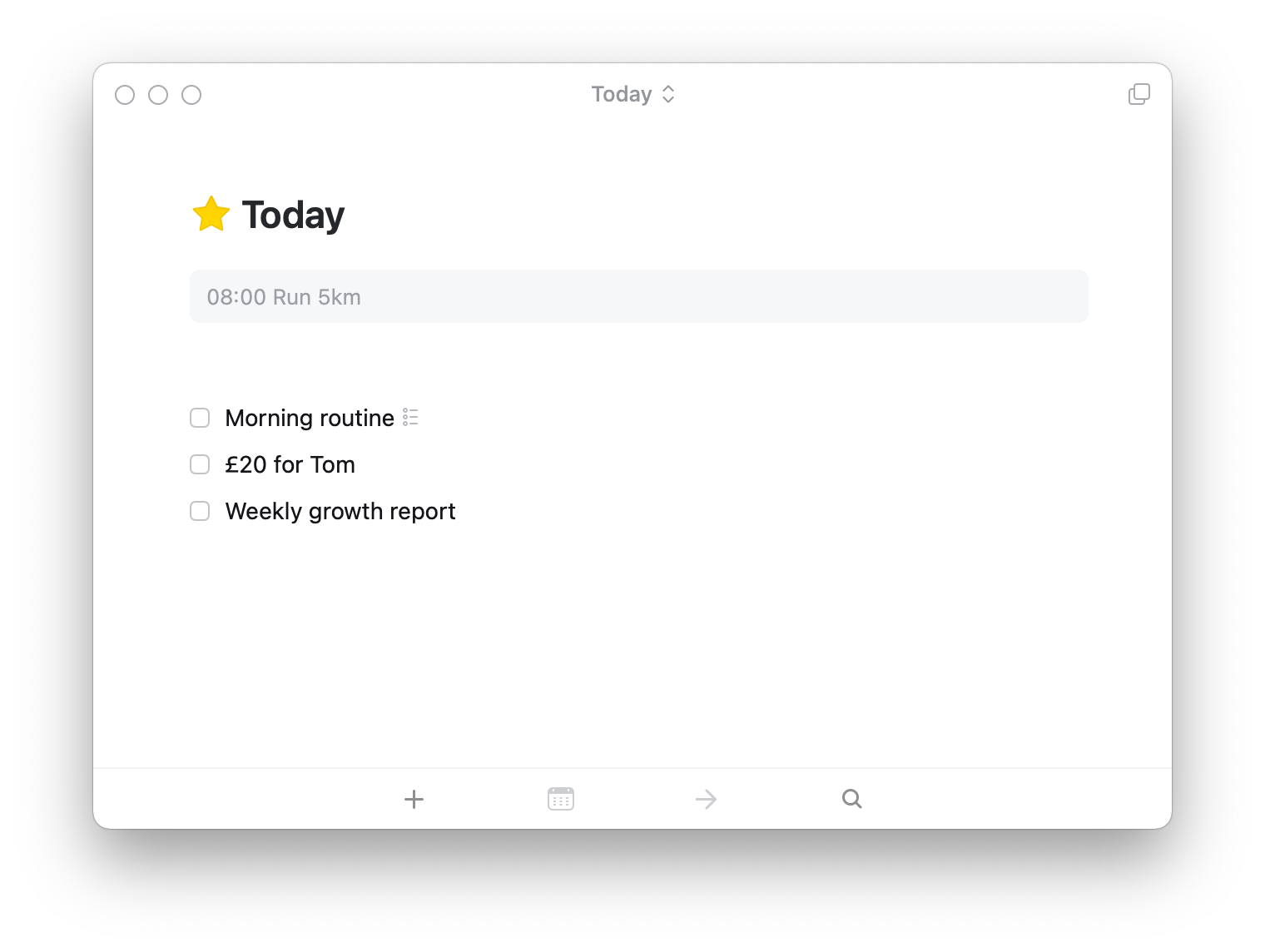
My todo list today.

I’ve lived my life with a daily todo list for over 10 years.

In fact, I put a video together to help you get started with Things for managing your todo list.

I get a small dopamine hit whenever I check an item off my list. I have built into my muscle memory the keyboard shortcuts to record anything anyone mentions to me that I’ll need to action in the future.

But every day I still finish with items unchecked. It gets me down and it stresses me out.

Earlier this week, several people sent me this post on how a CEO manages their time and it made me question my obsessive todo list usage. Is it really helping me? Is it contributing to me feeling down? Is it actually holding me back from focusing my time on what I need to do?

For the last few days I experimented with deliberately blocking my time on my calendar for the important work I needed to focus on. I have dabbled with this approach in the past but kept one foot in the “todo list” camp and it didn’t stick.

What I found from a few days last week was eye-opening:

  • I was more conscious of the tasks I put into my calendar (everyone on the team can see my calendar if they want to view it)
  • I blocked time to focus – and this time was protected from meetings. People couldn’t book / invite me to anything that clashed.
  • It drove my awareness of how much time I need to spend on certain important projects – time I wasn’t dedicating before.
  • It made me realise I go into every day, and every week, with an overly optimistic assessment of what I can achieve, that ultimately leaves me feeling like I haven’t achieved enough by the end.

I intend to keep this approach up. I am not ready to drop my usage of Things yet – especially not for my personal life todos.

I’m interested to find out after another few weeks of using my calendar more deliberately if I can learn about the following:

  • How much important work can I do? Not just the urgent work.
  • Can I get better at communicating with others around me what I can / cannot achieve by certain dates?
  • Can I feel better at the end of each day knowing I've focused my time in the right places, and achieved more with my time?

The clearer I can be with myself, the clearer I can be with everyone around me, and the more I can help people achieve their own tasks and projects.

Let’s find out!


Update: in episode 10 of Lost and Founder I share what I've learnt from using my calendar instead of a todo list over the 3-4 weeks since writing this post. TL;DR: it's helping.

Should you use Twitter Spaces or Clubhouse for live audio?

Clubhouse has been all the rage for months, but is it already starting to fade into irrelevance?

At GoSquared, we have been looking at how we can speak with our audience directly – we want to share more of what we’ve learnt with others out there, particularly with other people starting and growing SaaS businesses.

We have run a podcast in the past, and we’ve put together video content, and we’ve done a fair bit of blogging over the years, but live audio is something we’ve never experimented with at all.

So we wanted to give live audio a shot. But what is the best tool for the job?

Clubhouse is now a household name and synonymous for live audio streaming – it pretty much created the category. But Twitter has just released Spaces to more users – a product with extremely similar functionality to Clubhouse, but integrated into the main Twitter app.

I asked my audience (on Twitter, ironically) and the votes flooded in with a clear winner: Twitter Spaces is where to start a live audio stream.

Should I use this simple, mildly biased (users on Twitter will surely prefer audio on Twitter?!) poll, as gospel? I suspect not, but for the next week I will be trying Twitter Spaces out and seeing what happens.

Can I build an audience of engaged listeners on Twitter Spaces? Is my voice ready for the airwaves? Do people even want to hear what I have to say? All will be revealed once I try this out…

If you don’t already, please follow me on Twitter!