AI

A 4-post collection

Image optimisation in EcoSend

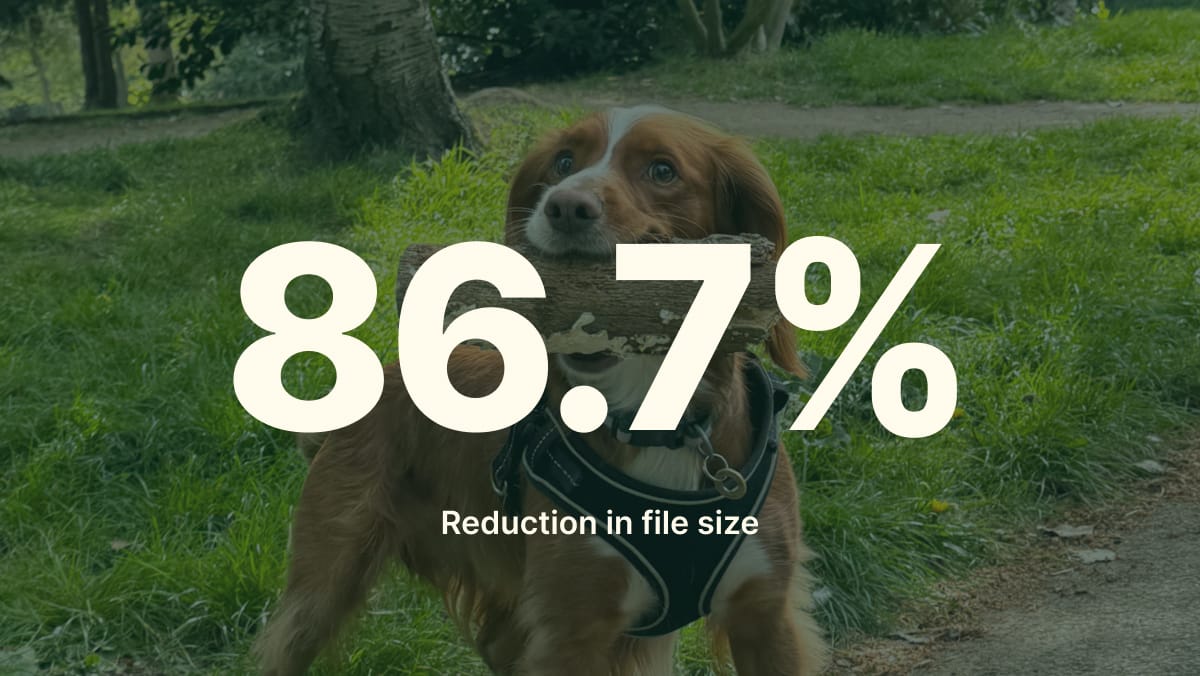
86.7% reduction in file size, overlaid on a photo of Hugo the spaniel.

I've wanted us to build this since the very first day of EcoSend, and I can't quite believe we finally have it: automatic image optimisation.

Almost every email carries an image of some kind, and it's far too easy to send something large enough for a highway billboard to people who'll only ever see it at the size of a post-it note.

Now EcoSend quietly fixes that for you — resizing every image to the size it's actually displayed at, choosing the best format, and compressing it as far as it'll go without losing an ounce of quality. In our own tests we've seen images shrink by over 86%, and it all happens invisibly in the background with zero extra work for users.

What thrills me most is that this took years of wanting before we had the foundations to do it properly. Building on our all-new email builder finally let us solve a problem we've been slightly obsessed with for as long as I can remember.

Every byte we save is a small win for deliverability, for the people opening emails, and for the energy consumed in the whole chain — and when you multiply that across millions of recipients, those wins add up to something quite meaningful.

More than anything, this makes me excited for what's ahead. Not just for EcoSend, where I think we're only getting started, but for software more broadly.

The best tools are the ones that do lots of hard, invisible work so people don't have to think about it. The constantly improving tools and landscape, with lots of help from AI, are enabling us to bring forward a future which once could only be dreamt of.

Siri is about to become good, but that’s not the problem

What happens when 1.5 billion people suddenly get a good AI assistant in their pocket?

In just a few days time, when Apple holds the keynote for WWDC 2026, we are likely to finally see (and hear) a Siri that doesn’t suck.

While this has been rumoured in the tech press, I don’t think most people are quite ready for how big of a deal this is.

And even if Siri stops sucking, it’s going to take a long time and a lot of advertising dollars to persuade people it’s actually true.*

Apple is a victim of its own doing. They are the boy who cried wolf on AI.

The lowest barrier to entry for AI


For years, the modern wave of AI has been mostly opt-in.

People have had to:

  • Download ChatGPT
  • Sign up for Claude
  • Try Gemini
  • Learn new habits

A lot of people have, of course, but many (most?) people still haven’t.

And even for those who have downloaded and used any of those apps, I suspect the majority of iPhone users don’t use AI regularly, or benefit from even a slither of its capabilities.

But everybody knows Siri.

Everybody has a button for Siri.

Everybody has a microphone for Siri.

Everybody has already been trained to understand the concept.

The problem was simply that Siri sucked.

If Siri suddenly becomes genuinely useful, Apple will be transforming an existing habit that they’ve spent years training users to be disappointed by.

It’s potentially enormous, but it’s going to take a while for people to catch on.

Learned helplessness

Siri has created a form of technological learned helplessness.

Users stopped asking difficult questions of Siri. In fact, many users stopped asking anything of Siri.

They learned the answer would usually be disappointment.

If Apple has fixed that, the hardest part won’t be improving Siri, but teaching people to try again.

How is Siri suddenly getting better?

Multiple reports suggest Apple is increasingly turning to Google and its Gemini models to power some of their AI ambitions. Google event tweeted about it:

You can look at Google’s latest announcements to get a sense of what’s coming to the iPhone. If you squint, repeat the announcements in a Tim Cook voice, and apply some Liquid Glass to the UIs, you’re on the right track.

Apple is essentially forming their own variant of a multitude of Gemini features and models.

If Apple doesn’t screw this up, then WWDC is sure to be a demonstration of great AI functionality actually coming to iOS and Apple’s other platforms.

You can also look at the recent accessibility features

I don’t want an iPhone 16

If you know me, you know I like a good Apple product.

In fact, you could say, I’m a little obsessed.

On Monday of this week, Apple held its annual event for releasing their most crucial products: iPhone, Apple Watch, and AirPods.

Before I share a summary of the event, I must answer an important question that I am often asked by my friends and relatives the moment they realise a new iPhone is on the shelves:

Are you buying the new iPhone this year?

My answer is No.

It’s not because of my focus on personal finances.

And it's not because these updates are the most minor year-over-year improvements in memory.

It's because I'm finding ever more enjoyment from making things last.

I'll admit, it feels easy to say this when both my devices are barely one year old. Let's see where my mind is at next year.

More than ever, though, I see the cost of a new iPhone or any gadget beyond the price tag. The materials, the processes, the energy, the shipping.

Even if Apple is pushing for a more sustainable supply chain, and reducing their emissions as fast as they can, there's nothing more sustainable than using your devices for longer.

So, my purchasing decision aside... what did Apple release?

iPhone 16 and 16 Pro

Don't get too excited.

The iPhone 16 has some beautiful new colours, a new camera bump (similar to iPhone X but with larger lenses), and gets the new Camera Button. This is a clever button with a touchpad to make it easy to snap, zoom, and focus the camera.

iPhone 16 Pro got a shiny titanium bezel, the new camera button, and an assortment of other camera upgrades. It also now comes in a delightful gold colour.

One of the most controversial aspects of the launch of the new iPhones is Apple touting their ability to run Apple Intelligence.

Apple's own AI features make it easier to write and edit text, edit photos, and speak to Siri.

The small detail is that Apple Intelligence features aren't ready yet — so a lot of the great new functionality isn't on these new phones from day one.

If you've been holding off getting a new iPhone for many years, then these new devices are just great. As Apple always likes to say — they're the best iPhones they've ever made. Thank goodness for that!

If you have one of last year's models, these are only small updates — this is to be expected in the 16th generation of any product, so you won't miss out on much if you only have an iPhone 15.

Apple Watch

Apple Watch reached a milestone: Series 10.

I remember my original "Series 0" Apple Watch and recall how much I enjoyed its introduction as a hugely anticipated product.

The Apple Watch persuaded me to wear a watch for the first

Feeling sorry for AI

You may know how to suggest 10 helpful recipes from nothing more than a blurry photo of some ingredients.

You may know how to create a dramatic photograph from nothing more than a few sentences.

You may know how to write a witty one line joke that entertains the reader.

You may even know how to suggest a gift for Mother’s Day.

But you will never know the deep joy of tasting that first bite after cooking a meal for five hours.

You will never know the tingle on the back of one’s neck when a picture takes the viewer back to a heartwarming moment in time.

You will never laugh your belly off at a witty line delivered by a hilarious actor.

You will never experience the unparalleled love that a parent can have for their child.

AI is the star of the show right now — a daily headline around the world. It’s smarter than anything we’ve seen before.

But what does it mean for our future to have a force that is so intelligent, without feeling or true, deep emotion?