iPhone

A 5-post collection

Introducing Hotshot: a little app to track your caffeine intake

I drink a lot of tea. There's rarely a moment in the day where I don't have a hot drink in hand.

But at some point in the last year I started to wonder: with all these drinks, how much caffeine am I consuming?

And how does that compare to the recommended amount?

And how much caffeine is in tea anyway?

And how does that differ to a flat white at my local coffee shop?

And what does all of this mean for my sleep?

Is this all related to why I struggle to wake up early every morning and desperately need a lie-in on a Sunday?

After just 19 years of using and loving the iPhone, I finally made an app. An app that answers all of these questions and more. An app that is live on the App Store.

Get Hotshot on the App Store

I'm so excited to have built something that I (and now you!) can use on the devices we hold in our hands — it feels quite profoundly different to building web-based software. The result is something more intimate, that feels more personal, almost like a physical product.

A screenshot of the Hotshot app on an iPhone 17 Pro

Just a year ago, this would have been completely impossible for me. For as long as I've been working, I've been able to design — but never build or ultimately ship software.

This is both the final step of a long journey, and the very earliest start of a new one: of ideating, designing, building, and shipping real working software.

If you're interested in how the app works and what it does, I created a dedicated page to learn more about Hotshot for caffeine tracking.

I hope you like it, and I hope you download the app.

If you do, I'd love to hear what you think.

If there's anything I've learned from all my time working in the world of software, it's that you should launch before you're really ready (absolutely true here), and that your work is never, ever done.

Enjoy your next cuppa!
GoSquared on iOS, coincidences, and medieval beats — Weekly Roundup

This week we released our first major integration for GoSquared in a long time: Numerics.

You can now get your GoSquared analytics data on all Apple platforms (iOS, Apple Watch, and even on Vision Pro) for the first time ever. I’m so excited for this — we’ve wanted to bring GoSquared to the iPhone since… well, the beginning of the App Store.

Numerics integration for GoSquared

Other notes from the week

  • On a walk in my local high street I stumbled on a plaque on the side of a shop. By some incredible coincidence, I noticed it on the exact day, 80 years on from the event it marks. Dulwich Society Plaque and August 5th 1944.
  • I’ve gone back and forth on my belief in AB tests. They can be helpful but they can also be a lazy, if not misleading way to make decisions. The team at Equals put forward a strong case for why startups shouldn’t bother with AB testing.
  • Do you like medieval music? Ever wanted a beautifully designed piece of audio equipment dedicated to generating medieval beats? I thought so! The weirdest gadget I’ve seen in years, designed by Teenage Engineering. I love it.
  • I posted a few more episodes of Lost & Founder on YouTube.
  • I’m in Edinburgh for a few days for the Fringe. A beautiful city bursting with incredible talent and buzz, a melting pot of creativity, laughter, and culture.
  • The Paris 2024 Olympics is now over. It’s been incredible, and has had me reliving moments from London 2012. As usual, the BBC put together a beautiful montage of Team GB’s incredible games.

A quote for the week ahead

“A ship in port is safe, but that is not what ships are built for. Sail out to sea and do new things.” — Grace Hopper (a US Naval officer and an early computer programmer)

Consistency is boring

"It looks almost the same as the last one!"
"It's surely not worth upgrading from last year's model!"
"Apple has really lost its ability to innovate lately."

Another year, another iPhone.

But this is how Apple rolls.

People remember the exciting moments. People get excited for the shiniest things.

But often, success comes from the boring: being consistent, executing relentlessly, not letting things slip.

Apple may not be able to hang on to their success forever, but since 2007 they have shipped at least one new, successful model of iPhone every single year. They didn't even let a global pandemic get in their way.

They’ve never once slipped up — no exploding batteries, no massively unpopular designs, no unexpected huge delays.

That’s boring, but that’s a big part of what has turned the iPhone into a business that generates $200 billion per year.

Most of us aren't running a global consumer electronics business, but I think there's something to take away for all of us — whether you're a founder, an employee, or just trying to improve in your personal life.

Often the success comes not from a single moment of genius, but from the compounding effects of showing up consistently and not giving up.

"We are what we repeatedly do. Excellence, then, is not an act, but a habit." — Aristotle

iPhone 12 Pro

I’m a total Apple geek, and I’m not ashamed to admit it.

As soon as I had a chance, I pre-ordered the iPhone 12 Pro with the goal of receiving it on launch day.

The unbelievable strength of Apple’s marketing prowess dawned on me – I didn’t make a rational decision, I didn’t think too much – I decided and I purchased.

My previous iPhone has been the iPhone X – and it’s been a fantastic companion for three years.

To Pro or not to Pro

This was the primary area where I was surprised at how little I thought about the purchase. The iPhone 12 and 12 Pro are both incredibly good devices. And there is hardly any trade off by choosing the 12 vs the 12 Pro. It’s primarily about cameras and “look and feel”.

There are some software features that Apple holds back for the Pro only – primarily, one could argue the reason for some software features only being availble on the Pro is the extra 2GB of RAM. But it feels like there’s increasingly a decision from Apple to use software to distinguish between models, rather than just hardware.

What I realised in this process of choosing the iPhone 12 Pro is that Apple has made me classify myself. I knew I wanted the Pro instinctively. I mentally tuned out of what the 12 could do and jumped straight to the Pro. Why? I don’t know – it feels like it’s hard wired into me.

This is crazy, because in many ways I love the look of the iPhone 12 – with aluminium band, and the fact it’s a little lighter.

Pre-order day came and I made my purchase. Launch day came, and I eagerly anticipated the delivery.

Packaging

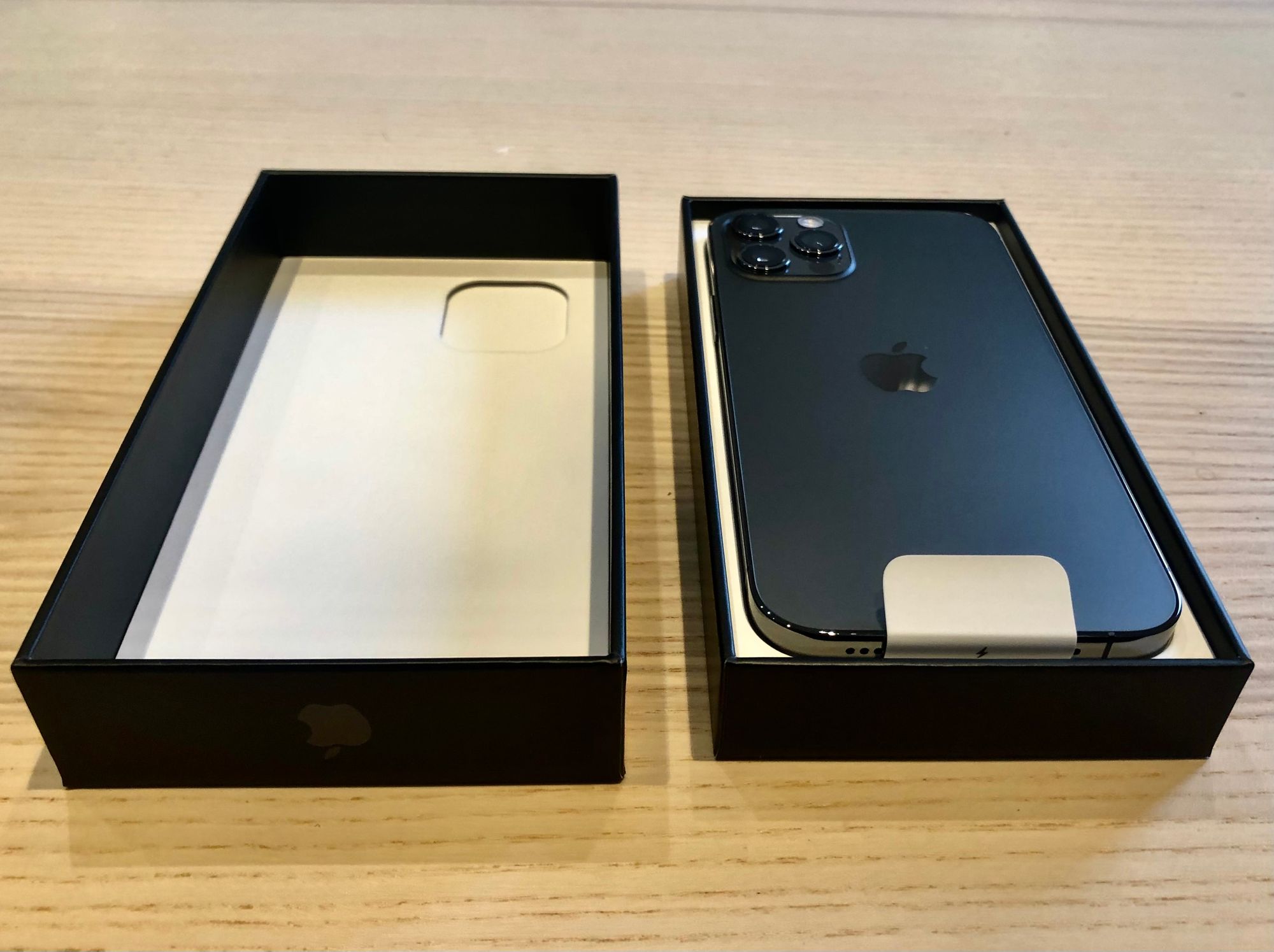
iPhone 12 Pro unboxing

There’s been some fuss around the new iPhones coming in a tiny box and Apple choosing to not include a power adaptor or headphones.

Initially my reaction was: “come on, Apple!” With regards to the lack of a charger – especially given the cable that ships in the box is a new USB-C cable rather than a traditional USB 2.0 cable. For those unaware, USB 2 ports are the kind that people started wiring into their wall sockets in the UK several years ago, somewhat shortsightedly.

In reality, the decision to remove these accessories makes a ton of sense – and I am finding it hard to complain. Smaller boxes (considerably smaller boxes – to the point where I thought the delivery driver had given me a SIM card and some O2 packaging, and not my iPhone) are good for the planet, and therefore everyone.

I have enough old Apple Lightning cables and adaptors around my house to keep me going for some time. In actual use, the lack of adaptor in the box is nowhere near as big of a deal as the now ancient switch from Dock Connector to Lightning. Everyone will be

iPhone X

I've spent about a week with iPhone X now.

While I doubt the world needs another review of Apple's latest device, every time people see it they have questions, so here's a few thoughts I've been keen to jot down.

When you work in the software world, it's easy to get so caught up in the latest gadgets, innovations, and ideas that you forget most people in the world don't live and breath tech every day.

Last weekend, I popped home to Kent to celebrate bonfire night, let off fireworks, burn an effigy of Harvey Weinstein, and talk iPhone X with my extended family.

A conversation with my uncle

So, how’s this one different to your old iPhone?

Well. It’s got no home button. It’s just all screen.

Oh right…

Yeah! So you used to use your fingerprint to unlock (like an animal) – you now use your face.

So does it actually work?

Yeah! It really does! Look let me show you!

Tries Face ID. Points it to my sister – nope. Points at me... – It works!

(This was a far more successful demo than at the Apple keynote)

Oh cool, so is that the difference then?

Well, no, that’s not all, you can now use the tech behind Face ID for loads of other cool camera stuff – like… erm… well it’s got Animoji.

Animoji?

...

Yeah, let me show you...

So this is what we've done with the world's most advanced technology? Talking poop?


To a lot of people, iPhone X is simply "this year's iPhone".

They haven't watched the keynote. They haven't studied the Apple site in detail for ridiculous amounts of time. They haven't been tuned in to MacRumors for months.

Thank God for that – most people are far more grounded and sensible with their time than me.

My last iPhone was an iPhone 6 – I was thrilled to get this device back in 2014. That iPhone introduced one of the biggest changes to the lineup – a highly anticipated larger device with a larger screen.

But in the three years since then, Apple's "lack of innovation" has seen a swathe of incremental improvements compounding to make switching from iPhone 6 to iPhone X a huge step up in experience.

Face ID

Touch ID is an action. Face ID is invisible.

We talked a lot about "courage" last year when Apple removed the headphone jack launching iPhone 7. Arguably it took even more courage to remove Touch ID in favour of a totally new, unproven technology as the primary way to authenticate iPhone X.

On day one, I'll be honest – I had a few hiccups with Face ID. I didn't realise how often I unlock my phone when it's very low compared to my face. I wear glasses too – and when I first set it up, I didn't have them on.

After